Have you checked out the book trailer yet? Don't forget to check out the revamped www.warmastersdaughter.com as well!

Showing posts with label writing. Show all posts
Showing posts with label writing. Show all posts
Monday, August 12, 2013

Monday, June 24, 2013

Monday, June 3, 2013
Second Edition of The War Master's Daughter
Just a quick update on exciting progress: The War Master's Daughter will be temporarily unavailable in paperback while the second edition is being proofed. The new edition will have a new cover, new foreword, and a new map, which was just completed last week. I'm anxiously awaiting the new proof right now! The eBook is still available via Amazon and Smashwords.
I'll shortly be scheduling a release party where we'll be debuting the new book trailer, which Liquid Squid has been working on for over a year!
In other news, drafting my second novel, Bugged, is coming along swimmingly with the chorus of cicada providing some much needed inspiration. I'm aiming for a 2014 release.
I'm also the proud owner of SMLXbooks.com and will be moving my website from the novel-centric warmastersdaughter.com to a site dedicated to the SMLX Books publishing collective, the model for which I'm designing with some of the most creative folks I know.
Don't forget that you can like SMLX on Facebook for more frequent updates and fun posts about books, and follow me on Twitter for incredibly frequent updates.
I'll shortly be scheduling a release party where we'll be debuting the new book trailer, which Liquid Squid has been working on for over a year!
In other news, drafting my second novel, Bugged, is coming along swimmingly with the chorus of cicada providing some much needed inspiration. I'm aiming for a 2014 release.
I'm also the proud owner of SMLXbooks.com and will be moving my website from the novel-centric warmastersdaughter.com to a site dedicated to the SMLX Books publishing collective, the model for which I'm designing with some of the most creative folks I know.
Don't forget that you can like SMLX on Facebook for more frequent updates and fun posts about books, and follow me on Twitter for incredibly frequent updates.
Tuesday, October 16, 2012
The Power of Punctuation
Thanks to Aubrie Dionne for inviting me as a guest blogger on Flutey Words!
Earlier this week, Facebook rolled out a feature that turns punctuated emoticons like this :) into small illustrations in the comments you post. So it seems an apt time for us writers to remind ourselves that punctuation has a far grander purpose than to wink at your reader.
When mucking through a first draft, punctuation is usually the last thing on a writer’s mind. One may give it a second thought during the final polish stage, but this thought is more toward correction than choice. Whereas so many writing techniques seem to fall along a spectrum, we think punctuation is binary: right or wrong, required or not required. Its becomes not an option to be considered but a rule to be remembered. We think, “Is a semi-colon correct here?” Hardly ever: “Is a semi-colon the best choice here?”
I’m here to tell you that punctuation is one of the most powerful tools in your writer’s tool box and that you ought to consider periods, commas, dashes, colons, etc. to be a subset of your greater Writer’s Alphabet—which is not just twenty-six letters, but the entirety of your keyboard. . . .
Read the rest of this post on Flutey Words!
Earlier this week, Facebook rolled out a feature that turns punctuated emoticons like this :) into small illustrations in the comments you post. So it seems an apt time for us writers to remind ourselves that punctuation has a far grander purpose than to wink at your reader.
When mucking through a first draft, punctuation is usually the last thing on a writer’s mind. One may give it a second thought during the final polish stage, but this thought is more toward correction than choice. Whereas so many writing techniques seem to fall along a spectrum, we think punctuation is binary: right or wrong, required or not required. Its becomes not an option to be considered but a rule to be remembered. We think, “Is a semi-colon correct here?” Hardly ever: “Is a semi-colon the best choice here?”
I’m here to tell you that punctuation is one of the most powerful tools in your writer’s tool box and that you ought to consider periods, commas, dashes, colons, etc. to be a subset of your greater Writer’s Alphabet—which is not just twenty-six letters, but the entirety of your keyboard. . . .
Read the rest of this post on Flutey Words!
Saturday, June 30, 2012
Must a Novelist Read Mostly Novels?
I love math. I know this is strange coming from a writer,
but it’s true. I think that, when so often mired in the vast gray area that is
language and narrative, I find solace in the
black-and-whiteness/wrong-and-rightness that math offers. I find elegant beauty
in a spreadsheet, the way you can put in the numbers you have, arrange them
just so, and find answers—real answers, correct, indisputable answers—to big
questions. I love statistics and charts, and (while they can be interpreted in
many ways to many ends) numbers themselves do not lie.
All of this is to say that I’ve come across some interesting
numbers in my life as a writer and reader. As you may know by now, my preferred
medium is the novel. I consider myself a novelist. While the vast majority of
my life is spent on business writing, writing novels is my calling. It’s what I love the most; it’s what I do for fun. I do it
even though I’m not making money on it.
Now, keeping in mind who I am as a writer, let’s consider
who I am as a reader. Out of the last 30 books I’ve started and/or finished
(and you can verify this for yourself), it breaks out the following way:
- 1 graphic novel (2, if you count Eric Drooker’s Howl here)
- 2 books of poetry (1, if you count Howl under graphic novels)
- 3 short story collections
- 7 novels
- 17 non-fiction books
And it is important to point out that, out of those 7
novels, I only finished 4. (I no longer finish novels that I am not enjoying by
the midpoint. #YOLO.)
This list, of course, is limited to book-length material,
but I also extensively read short works—essays, articles, scholarly papers,
Supreme Court rulings—and I would estimate that, in recent record, 95% of this
reading is non-fiction. (Though, I did recently read “Super-Toys Last All Summer Long” and "The Extinctionists" on Instapaper.) The last new book I bought, which I am practically drooling to
crack open, is also non-fiction. When I put on my stereo while I’m cleaning, I’m
far more likely to listen to Radiolab than Radiohead (though, when I’m writing,
I listen to Radiohead more than anything else…). If I want a quick bite of
television, it will be a TED Talk before it’s a sitcom.
What does it mean that well over 50% of what I consume is
non-fiction, that only 14% of my reading consists of novels that I actually
finish?
This recent revelation is throwing me for a loop. Is it
possible for a novelist to love something more than novels? Am I secretly a
non-fiction writer? Have I been hacking away at the wrong destiny?
Here is my answer to these questions. I am a learner and a
seeker. This is why I read; this is why I write. I am drawn to non-fiction
because it gives me raw materials: information, facts, the stories of how real
people lived and live. Fiction is the means by which I synthesize this
information into the philosophies and ideas I want to explore. In The WarMaster’s Daughter, I tackled gender issues, war, religion, the meaning of “family.”
My new book, Bugged, explores psychology, neuroscience, entomology, and
medical ethics. Non-fiction inspires me with the patterns and anomalies of the
existing world. It teaches me what we’ve collectively figured out, and where we
still have incredibly complex questions.
On the other hand, the ideas in novels, by and large, are
already synthesized. The author is asking questions in a particular way, making
particular points, choosing which themes and ideas rise to the top. This offers intellectual and emotional pleasure; that’s why we read. However, it’s not
the stuff that makes me want to push my fingers into the clay. To extend a
metaphor, I find a set of paints much more inspiring than a painting. I love to
experience a beautiful painting, but the only thing I can learn from viewing a
painting is craft. The art comes from living and learning and
synthesizing all the ideas that exist in the world. Van Gogh did not paint
because he saw another painting; he painted because he experienced the world.
So what does it mean about me as a novelist that I don’t
gorge myself on novels? I supposed I’d rather my readers judge that for
themselves. I hope my books are appealing to the learners and the seekers out
there; I hope they appeal to fiction and non-fiction lovers alike.
What about you, dear reader? When you take an honest look at
what you consume above anything else, what is it? Does it surprise you? Is what
you really like different from what you think you like? How does what you read
affect what you write?
Saturday, June 23, 2012
Keep On Truckin'
I admit defeat: 1,000 words per day was an impossible goal for me. My job has become more demanding than ever, with my creative energy levels almost fully depleted by the evenings. (But that's another story.) So I've recalibrated to a much more sane 500 words per day. It sounds low when you compare it to, say, Stephen King's stated daily count of 2,000 words. However, King doesn't have a 9-5 with a 45-minute commute each way. I have about 4 hours by the time I get home from work till the time I need to be in bed, and in that time, I have to have dinner, do any necessary chores (dishes, laundry, vacuuming, bathing...), interact with my partner, and squeeze in any reading and/or writing I want to do.
I could probably write 1,000 words of crap, but I've already stated why I think that's a bad idea. In fact, I've also stated why I think it's a bad idea to work via word count at all. So why do I still have a daily word count at all (hypocrite!)? Why am I still keeping this chart?
So maybe I was wrong before; maybe I was right but I'm not smart enough to heed my own advice. In any event, I still have a daily word count goal. And I'm finding that 500 words is perfect for me. I find that I can accomplish it even after a bad day at work, and that makes me feel satisfied and productive--key to keeping up a daily writing pace. I find that after a fairly calm day at work, I can accomplish twice my goal or more, and that makes me feel like the queen of the world. And it also means that when I have a particularly godawful shit day at work and can't do anything but pour myself a gin and tonic and stare at the wall, I don't lose much ground.
So I'm making measurable, consistent progress, AND bonus: I feel good about myself. I'm about one-third through the book, and it's going to be exhausting as a marathon to get it done. Keeping myself feeling GOOD about myself and my writing each day, again and again, is the key to progress. Feeling accomplished without feeling overwhelmed is awesome. I know what burning out feels like. I don't, I can't burn myself out on the thing I love most in the world.
The slope may be shallower, but the progress is still upward and onward. I'm aiming for publication by December 2012. Can I do it?

I could probably write 1,000 words of crap, but I've already stated why I think that's a bad idea. In fact, I've also stated why I think it's a bad idea to work via word count at all. So why do I still have a daily word count at all (hypocrite!)? Why am I still keeping this chart?
- I need the motivation. I need a goal, and I need to meet it.
- Words written are what show progress toward a goal; time spent does not. I need to SEE the progress.
- It's pretty.
So maybe I was wrong before; maybe I was right but I'm not smart enough to heed my own advice. In any event, I still have a daily word count goal. And I'm finding that 500 words is perfect for me. I find that I can accomplish it even after a bad day at work, and that makes me feel satisfied and productive--key to keeping up a daily writing pace. I find that after a fairly calm day at work, I can accomplish twice my goal or more, and that makes me feel like the queen of the world. And it also means that when I have a particularly godawful shit day at work and can't do anything but pour myself a gin and tonic and stare at the wall, I don't lose much ground.
So I'm making measurable, consistent progress, AND bonus: I feel good about myself. I'm about one-third through the book, and it's going to be exhausting as a marathon to get it done. Keeping myself feeling GOOD about myself and my writing each day, again and again, is the key to progress. Feeling accomplished without feeling overwhelmed is awesome. I know what burning out feels like. I don't, I can't burn myself out on the thing I love most in the world.
The slope may be shallower, but the progress is still upward and onward. I'm aiming for publication by December 2012. Can I do it?

Sunday, June 10, 2012

Friday, June 8, 2012
Writing Myths – Myth #2
As I’m working away on my new novel, I’m learning there is
advice out there that might not be everything it seems on the surface. Over the
next few posts, I will debunk some of the myths I’m facing during this process.
Myth Number 2: Don’t
edit while you write.
For over a week, I was really, really on a roll. Thousand
words a day, no problem. Then, suddenly
and seemingly without cause, I dreaded the idea of going back to my draft. This
premise has been my obsession, my passion. What could cause this story to be the
bane of my existence, seemingly overnight?
The answer was my unquestioning adherence to Myth #2. Still
in the NaNoWriMo mindset, I firmly believed I would only lose ground if I went
back and edited—nay, looked at—anything I had written. I was running
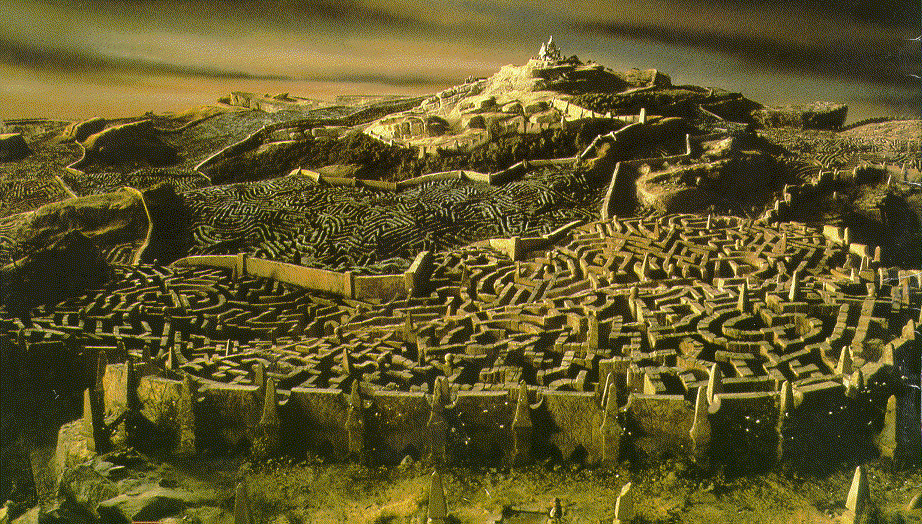
down the dark corridor of a maze as the lights snap off behind me as I moved
forward, the only direction available. But the problem with that was that I couldn’t go back and see if I had missed a crucial turn
along the way. So I just kept getting more and more lost, and feeling more and
more helpless because—as I clung to my rules, feeling deviation would cause me
to fail—I had no clear ability to find my way again.
(And I could feel Future Elly getting pissed at all
the clean-up she’d have to do during the editing stage.)
After a lot of long showers and laying awake in bed, I
realized that the problem was that I had started at the book in the wrong place. I
had skipped set-up and went directly into conflict. I hadn’t drawn the arrow
back all the way, so my characters didn’t have enough trajectory to carry the rest of
the book. If I had stayed dogged to the “rule” of not editing (and just
going with it), I would have
continued to struggle because I was building on an unstable foundation.
A Better Way:
Structural editing is A-Okay. In the
Twin Peaks pilot, there is a scene where an aspiring teen writer asks
her older sister Donna, “Which do you like better: ‘The blossom of the evening’?
Or ‘the full flower of the evening’?”

Watching it last night, I thought to myself, If that girl
is writing a novel, she is NEVER going to finish. A haiku, maybe. But when
you’re writing the big’uns, you can’t afford to stop your first draft progress
by lingering over word choice like that. You take care of that in the second or
third draft stage, but to worry about it before then, you’re going to lose the precious
momentum that allows you to figure out the bigger problems of plot and
character during the first draft stage.
So the “rule” stands at a copyediting and proofreading type
level. But as for structural editing, it’s a must, and it can't happen early enough. You
have to go back and at least skim what has come before, because—unless you are
way more organized than your typical creative personality, or a genius (plenty of sins can be forgiven if you're a genius)—you’re going to
forget things, confuse yourself, and/or end up with an inconsistent mess.
An example: When I worked in publishing, I content-edited a
thriller that went on to sell quite well. But I’ll let you know in on a secret.
It was the second in a two-book deal for this author; if not for that, it would
have gone in the rejection pile. There were significant plot holes,
including that he killed off one his main characters, then brought her back to
life! How do you miss something like that? This probably happened because he was moving in a forward trajectory
only. I can’t tell you the editing work and rewriting that went into getting
that book ready for publication. A lot of it could have been saved if the
author went back to do some structural editing as he drafted.
So while you don’t want to get hung up on what kind of
flower your evening is, you do want to keep the light on behind you.
Think of this as making switchbacks. You can see the path you just came from,
but as you seemingly moving backwards, you’re really moving upwards.
See you at the top of the mountain!

Sunday, June 3, 2012
Writing Myths – Myth #1
I’ve been working pretty consistently on the new novel now
for longer than I have on any recent project. It’s been 7 days in a row now
that I’ve consistently hit my daily word goal of 1,000 words. This is the first
time I’ve ever written this consistently and this productively when not
involved in NaNoWriMo. These might be the first tentative baby steps toward
being a real, live grown-up writer, and not someone just playing at it. That
said, it’s only been 7 days, and I’m bound to soon stumble and hit my head on
some unprotected corner of a coffee table.
This experience of writing consistently (which is, after
all, the one piece of advice that really doesn’t differ from one successful
author to another) has taught me that there is advice out there that
might not be everything it seems on its face. So, over the next few posts, I’d
like to debunk some of myths I’m facing during this process.
Myth Number 1: Set a
daily word count and write until you hit that goal.
If you follow this blog or have read the Acknowledgments in
The War Master’s Daughter, you know that I credit NaNoWriMo for my finally
being a published author. Now that I’m questing after my first non-NaNo book, I
look to the aspects of the contest that made me successful. The one that comes
to the forefront is that lovely little bar graph that shows your word count progress.
Boy does it boost your confidence. Boy does it motivate you. So I created my
own little bar graph and my own daily word count goal, attempting to mimic the
driving force that got me to write for so many days in a row.

However, in practice, I have found this particular piece of “advice”
to be the most damaging. Sure, the daily word count goal might work for
NaNoWriMo, where the goal is a certain number of words, and really nothing
else. But, as other WriMos know, we all end up playing little tricks with
ourselves to pad out the requisite 1,666 words/day. Contractions, begone. Evil
adjectives and adverbs, you are welcome on the doorstep of this bizarro writing
world. Characters, your middle names have never been so important.
Following this technique, I’ve written just over 15,000
words of my new book, or about 20% of my anticipated total final length, and
7,000 of these words have been over the last 7 days. I was impressed with my
progress—until I went back and read some of what I’d thrown in there. A lot of
those words are utter crap. A lot. WriMos are familiar with this phenomenon,
encountering it during the celebratory (or funereal) December read-through.
Haven’t we all had that moment of “What was I thinking?” And “How is it
possible that I wrote that badly for that many pages?”
Perhaps setting a daily word count works for you if you have
the luxury/curse of writing fiction for a living, and you need some sort of
self-imposed deadline to make your writing take precedence over, say, cleaning
the refrigerator, alphabetizing your DVDs, or vacuuming your cat. But when you
have a finite amount of time—cut in on by a 9-to-5 day job, weekend social
obligations, and chores that actually need tending—setting a word count
goal is a recipe for churning out crap. Yeah, you might find you occasionally pen
something diamond-like, but fast writing develops bad habits of lazy writing.
The mentality of “I’ll go back and fix it later; gotta gotta gotta get words
down NOW” takes the art and concentration out of the writing process, turning
it into something mechanical akin to shoveling dung. You can’t write
mechanically and write beautifully,
unless you are some kind of prodigy or a consummate professional with decades
of dedicated experience. When you’re an amateur—as in, doing because you love
it—writing for quantity instead of for purpose turns out to be a huge waste of
time.
And you’ll hate yourself when you get to the editing stage.

A Better Way:
Set a daily time goal.
As Pablo Picasso said, “Inspiration exists, but it has to find
you working.”
Rather than spitting out 1,000 words, no matter how long or
how short it takes (which, predictably, correlates with how much time you
actually have until you are required to be doing something else),
schedule daily writing sessions in manageable blocks.
Set one of those cheap, plastic kitchen timers for 60
minutes, then sit in your chair with your work open in front of you and don’t
do anything else except work. You might write 1,000 words. You might write one
sentence. But promise yourself (and keep your promise) that you won’t do
anything other than write. And if you’re not physically creating words and
sentences, you’re staring at your page, thinking about writing. Don’t do “research.”
Don’t check Facebook. Don’t fold the laundry. Do the work. When your timer dings, you can stop—or not. But you’ve
put in your time. The quality of the results will be higher.

Moreover, you’ll develop good habits. You won’t put down
words with the intention of fixing them later; you’ll put down words with
intention. Efficiency will come with time and habit—then you’ll have the best
of both worlds.
Saturday, June 2, 2012
I'm Not Sure This is Going to Remain a Reasonable Pace for Three Months
But I'll keep it up while I can.


Wednesday, May 30, 2012
Where in the World is Elly Zee?
See the last paragraph of this post. That's where I am. 11,000 words in and counting. I'm publicly announcing that a first draft will be done by end of August. Help keep me honest.
Monday, May 14, 2012
Wherefore YA Sci-Fi?
Fresh off the heels of finishing the short story referred to
in the previous post, I realize I have no idea what is meant by the cliché “fresh
off the heels” or “fresh on the heels.” (Is it an inadvertant combination of “fresh
off the presses” and “hot on the heels”?) George Orwell would shame me for saying that.
Let me start again: For the first time since roughly 2009, I
have a finished, polished short story that I am ready to put into circulation.
I wrote a few between then and now, but they were specialized for contests or
based on weird prompts. The story at hand is the first I’ve written in years
that was straight from the imagination, for no other reason than I had an idea
and I wanted to write it down. Felt pretty damn good, if I do say so myself,
and Present Me shall now say “nyah nyah” to Past Me who so recently denounced
writing short stories.
Now I face the daunting task of beginning to submit my short
story for publication.* This is a circle of hell with which I am intimately
familiar; I am both looking forward to and dreading re-entry. Surfing Duotrope today (a wonderful, free
alternative to Writers Market), I began narrowing down a list of publications
to which to submit my first round. I’ll save my whinging about hard copy
submissions for another post, but the target of this particular diatribe is one
certain publication that came up in my search results for a publication open to
soft science fiction short stories of about 4,000 words. [Anonymous Online
Magazine] described its needs thusly:
"We are looking for hard science fiction, soft science fiction, and everything in between. Think Jules Verne, Isaac Asimov, George Orwell or Ray Bradbury with a YA focus."
“With a YA focus”? Okay, so when I was a “YA,” my YA fiction
was Asimov, Orwell, and Bradbury—a lot of Bradbury. (Always and
forever, a lot of Bradbury. Fahrenheit 451 fits neatly into the category of read this, like, now.) It should be no surprise that I was a bookworm as a kid. But
the books I remember being affected by the most were not novels; they were
short story anthologies—more specifically, sci-fi and fantasy anthologies that
I rescued from a box of my father’s old books from his college days. I read TheIllustrated Man and The Martian Chronicles until they fell apart.
I used to sneak a copy of copy of Playboy’s 1966 Book ofScience Fiction and Fantasy into my 7th grade classes with a
different cover on it, because I was embarrassed it said “Playboy” and I didn’t
want to explain. The stories weren’t dirty, they weren’t graphic. But they
made me feel something unexplainable deep inside, like there was something darker,
bigger, stranger than myself out there, that there would always be something to
be explored, both at the outreaches of the universe and the inner reaches of my
soul. I lost my dad’s old paperback somewhere down the road, so a few years back, I
tracked down a used copy just to read all the stories again. They were as good
as I remembered. “The Fly” by George Langelaan! “I Remember Babylon” by Arthur
C. Clarke! “The Vacation” by Bradbury is still to my mind one of the most
perfect short stories I’ve ever read.
I don’t remember “YA” being its own genre when I was coming
up. As a young adult, I read a few YA books: some were great; some were not so
great. But they weren’t the books that turned me into a lifelong reader or
a writer. Sure, it was nice to see someone like me in a book, but the books
that dug in their claws and never let go were the ones that gave me a salty
glimpse of what it was like to be a grown up and still be frightened, whether
of what you might find on another planet or of what you might find in yourself.
This may not make me very many friends, but I have to
confess that I don’t “get” the whole YA thing. I understand it as a marketing
handle, but it ends there. I do believe that there are stories worth telling
about characters under the age of 18. But I think it is absolutely essential that
fiction not pander. Just like when a mother buys her child a coat or pair of
shoes that’s just a little too big so there’s “room to grow,” children and
teens should read stories that leave them room to grow. The best fiction shows
us ourselves, but also shows us an “other,” so that we may experience the world
outside ourselves. (As an aside, Max and Menna by Shauna Kelley is a
terrific example of a book marketed as YA that does not pander to its audience whatsoever,
but treats them as mature equals.)
As writers, it is not our job to tell our readers who they
are by writing something “focused” on who we decide they are. Rather, our job
is first to tell the truth, and then to let our readers discover their place in
the world through the stories we tell.
*I feel I should explain why I would seek a publisher for my
short story when I rally so vehemently against legacy publishing. I have my
opinions on this matter, and explain I will, but let’s save that for a future
post.

Friday, May 11, 2012
On the Productivity Problem
I took today off work specifically so I could spent today
writing. I did not write a single word until just now, when I wrote, “I took
today off work.”
I had a very productive day, as far as my heart, my soul, my
mind, my body. I read the writing of David Foster Wallace for the first time (a
fact I am both proud and ashamed to admit). I read more chapters of Walden(which has been so life-changing for me, I will not diminish it here with
commentary; just read it, like now). I took a walk, practiced Tai Chi, gave myself a Qi Gong tapping
massage, and ate no meat. I cleaned the apartment and sufficiently snuggled all
three cats. I listened to a Radiolab podcast that made me cry my way through a
sandwich and realize a level of therapeutic purging I did not know I needed. I
did many things today that enriched me as a writer, and yet I did no writing.
I’m having a productivity problem. More specifically, I have
a finishing problem. I feel like Sozi; I am Sozi. I have a million
ideas, each one a seed, and I want to see that tree so badly that I plant them
all in the ground, give them some water, see that first shoot of green, and
marvel—but in moments I’ve found another seed.
I have this fancy notebook and this fancy pen, and I only
write in the fancy notebook with the fancy pen, and I only write in the
notebook fiction or fiction-related ideas. (Other creative types may recognize this
affected ritual in which we find comfort.) It’s my ideas journal, sometimes
drunken rambling diary, sometimes observation record, sometimes organizer and
planner. But it’s all in the name of some present or future fiction. I flipped
back through its pages today and realized I started it almost exactly a year
ago, give or take 11 days. It’s filled just over halfway with seeds, saplings,
and one full-grown tree. Notes for at least four novels are in there, and about
the same number of short story sprouts.
I have to admit that I have three active novels in various
states of undress, and I feel like I am doing everything in the world not to work on them. I have one novel
that is, at this point, 95% done. But I want to work on it less than I want to
do almost anything else in the world, including cleaning the litter boxes of
aforementioned three cats. I really love everything about it, except I hate
that I wrote it instead of something more “important.” I almost can’t work on
it because it makes me feel this crippling self-doubt that I may never be the
writer I want to be, and if I finish and publish this book I am somehow
carving that in stone.
I have a second novel that is fully drafted as a novella,
and merely needs to be extended in accordance with the fully detailed outline
contained in my fancy notebook. Much of the work is done. But the story itself
is extremely depressing and I find I cannot work on it without feeling that the
sadness of the material will seep into the edges of my life and I may lose what
sense of peace and happiness I’ve worked so hard to attain. I also worry that
if I publish such a story I will be bringing sadness into a reader’s life,
instead of hope and enlightenment. Again, I feel like it would make me
dishonest in my most basic intentions as a writer.
The third novel in progress is the least far along. I have a
full outline and a few fragments, but there are more than likely years
of work left on it. Yet this is the one I can’t stop thinking about. I dream
about it. Everything I read or watch on television or talk about over a beer
seems directly relevant to the story I want to tell with this book. In my head
it’s already done, and I am sometimes surprised when I notice only about 10
pages are written down. But every time I feel the urge to work on it, I
mentally chastise myself for not working to finish the others that are so close,
that I am procrastinating from my other work with this work out
of some fucked up fear of success/fear of failure syndrome. . . . And so it
becomes a cycle, and I work on nothing.
Just last week I was telling a friend how I thought I was done
with the short story form and at heart I am really a novelist and I ought to
really just focus on novels. And instead of novelling, I just finished the
first short story I’ve written in years. I also wrote a screenplay, for
crying out loud. I don’t write screenplays. I’ve taken procrastination to a
weird new extreme wherein it is actually making me productive at things I don’t
think I want to do.
Perhaps I finally turned to the short story and the short
screenplay because they were pieces I could finish. I kind of want to
write another short story; I already have the idea. It’s in the fancy notebook.
But, like something near the horizon, I sniff the pressure and doubt on the
wind. If I write two short stories, I really ought to write eight more so that
I can publish a full collection. And if it’s going to be a collection, there
ought to be some thematic thread. Sure, these first two go together, but what
if I can’t come up with any more that match? Why bother writing the second if I
can’t write the third, fourth, fifth . . . ?
So you see the spiral. I believe it’s a product directly
related to my acute awareness of the passing of time, and of my own mortality. It
took me 15 years to put out my first book. I don’t have very many chunks of
time that long left. I don’t actually think it will take me 15 years to finish
my next book, but at this rate, who knows? Maybe it is the fear of success/fear
of failure. Maybe it’s the sophomore slump to the wildly mediocre success of my
freshman try.
I want to say I don’t know the solution. I want to whine
some more, bitch and moan, and google “motivation for writers.” I want to
blame. But I do know the solution. You can see it, a few paragraphs above. The
story that I dream about? The story I wake up thinking about? That’s the story
I need to write. I shouldn’t care that I only have 10 pages done. I can only
write one word at a time. I just need to do that, every chance I get, until I’m
done.
A friend recently asked me for some motivation advice. I wrote back something that may or may not have actually been helpful, but I am positive it reeked from the overconfidence of someone who never ever suffers writer's block--which, as you can see, is patently false. The advice I ultimately ended with was "Write now. Right now." I should take my own advice. And that’s why this post will end so suddenly.
Thursday, April 12, 2012
Lucky 7 Blogfest
Rance Denton just tagged me over at The Action Prose for the Lucky 7 Blogfest. I'm so glad too, because, like Rance, I've been so busy writing, revising, marketing, and doing all sorts of authorly stuff, that SYEWW has been stalled. This is a great, fun excuse for a post. And the best part is that it doesn't take too much brain power, because writing, revising, marketing, and doing all sorts of authorly stuff doesn't leave you with much mental horsepower.
I have two simultaneous works in progress (to assuage my two different personalities, obviously), so I thought I'd treat you all to bits from both. The rules for Lucky 7 appear after the excerpts.
Excerpt from page 7 of Bugged:
Excerpt from page 77 of [untitled] cozy mystery, to be mysteriously published under a mysterious pseudonym:
Funny that both random excerpts are one-on-one dialog during the course of drinking alcohol. I hope I'm not becoming . . . samey. Seriously, though, these works couldn't be more different. Just a neat coincidence.
The way the Lucky 7 blogfest works is this: 1) If you’re tagged in a post by an author, you can choose to take part (which I hope you do!); 2) Go to page 7 or 77 of your current work-in-progress, go down to the 7th line, and post on your blog the next (approximately) seven lines! It’s as simple as that. 3) Remember not to cheat! Don’t pick a part you think will be engaging; don’t edit; just post it, show the raw, unedited truth of a writer’s first draft; and 4) Tag some of those writers you know would be wiling to show a bit of their creativity.
I'm tagging seven of my friends who write, and who I know--or hope--have a current WIP. I hope you'll respond on your blog or a Facebook note!
Kelly Leard
Jes Goodyear
Laura Bogart
Gavin St. Ours
Shauna Kelley
Jenna Morton-Aiken
Josh Munro
I have two simultaneous works in progress (to assuage my two different personalities, obviously), so I thought I'd treat you all to bits from both. The rules for Lucky 7 appear after the excerpts.
Excerpt from page 7 of Bugged:
Finally swallowing, he said, “You’re right. Not everything is different to everyone. Most sensation is linked to physiognomy. So barring some genetic anomaly, we basically see the same, smell the same, taste the same.” Swish, swish. “But of course, not you, Richard the Supertaster.” Sometimes he had to flatter Richard to make sure he was still listening.
“I can’t help it if I have access to thirty percent more taste buds than you.” Richard flicked his pink tongue out over his fat bottom lip. Ever the sucker for old fashioned flirtation.
“But there is so much about perception that isn’t actually linked to the physical sensory organs. Things that are linked to the intangible, emotions, gut feelings. You perceive fear, but that doesn’t always stem from physical stimuli. You can’t even always explain it. What scares you might be nothing to me, and vice versa.”
Excerpt from page 77 of [untitled] cozy mystery, to be mysteriously published under a mysterious pseudonym:
“Couldn’t he just be someone you know?” I ask. I take a sip of my drink and I actually like it. But it’s strong, really strong, and I promise myself not to have another. “I’m sorry. I mean, are you sure you want to talk about this?”
“Absolutely!” she says emphatically. “I confess I had ulterior motives to inviting you over. Sometimes, I just need to vent. And Maury’s pretty much put a gag order on me about the whole thing. He thinks media attention just fuels this guy. And Maury’s not the type of person you can sit down and have a heart-to-heart with.” She whispers confidentially, “I need a girl to talk to.”
Funny that both random excerpts are one-on-one dialog during the course of drinking alcohol. I hope I'm not becoming . . . samey. Seriously, though, these works couldn't be more different. Just a neat coincidence.
The way the Lucky 7 blogfest works is this: 1) If you’re tagged in a post by an author, you can choose to take part (which I hope you do!); 2) Go to page 7 or 77 of your current work-in-progress, go down to the 7th line, and post on your blog the next (approximately) seven lines! It’s as simple as that. 3) Remember not to cheat! Don’t pick a part you think will be engaging; don’t edit; just post it, show the raw, unedited truth of a writer’s first draft; and 4) Tag some of those writers you know would be wiling to show a bit of their creativity.
I'm tagging seven of my friends who write, and who I know--or hope--have a current WIP. I hope you'll respond on your blog or a Facebook note!
Kelly Leard
Jes Goodyear
Laura Bogart
Gavin St. Ours
Shauna Kelley
Jenna Morton-Aiken
Josh Munro
Tuesday, April 10, 2012
Another Positive Review!
Blogs are picking up on The War Master's Daughter!
Check out the review on Alien Red Queen:
The book continues to get positive reviews on Amazon, maintaining 5 stars. Check out what people are saying!
Check out the review on Alien Red Queen:
"But probably what is the most impressive about this debut novel is Zupko’s use of smooth transition between past and present as a technique for controlling the pace and plot development of the story. Though the cast of characters is fairly small, given the isolated nature of the main character’s predicament, and this makes it easier to discern possible plot twists, Zupko still manages to surprise and engage the reader. She manages what could have been a rather standard and boring storybook ending – 'and they all lived happily ever after' – in a way that leaves the reader something to ponder. I genuinely didn’t want the story to end.
"The War Master’s Daughter is likely the beginning of what I hope is a long and prosperous career in fiction for Elly Zupko, and well worth a read." [read more...]
The book continues to get positive reviews on Amazon, maintaining 5 stars. Check out what people are saying!
Thursday, January 12, 2012
New Review for TWMD
A beautifully written and insightful review of The War Master's Daughter has just been posted over at The Action Prose, a great in-your-face writing and life blog by @RanceDenton.
"To suggest that Elly Zupko’s The War Master’s Daughter is merely a historical fiction novel would be to ignore a great number of its evident strengths. Simultaneously, pigeonholing the novel into any specific genre would be to discredit its willingness to step outside its comfort zones. The greater part of The War Master’s Daughter is confused about what genre it may actually be, but that doesn’t draw away from the novel’s overall quality. Zupko’s book is a fantastic independent offering the intense strengths of which outweigh the few moments where its footing occasionally wavers.
..."[read more]
Thursday, December 8, 2011
A New Look and a New Outlook
It's been a truly crazy couple of weeks. I know my friends and family miss me. I know I need to wash the kitchen floor and repaint my toenails. I could stand to go back to the gym, oh, every day for three hours for the next month. Unfortunately, the phrase "worked my ass off" has only been a metaphor.
My nose may be a bit scraped up from the grindstone, but I was able to get The War Master's Daughter out almost on schedule. The site has been redesigned with a new look, and I think it's rather pretty and inviting (despite the gothicky pull quotes). Check it out, if you have the chance.
You'll also notice that the book itself is now available for pre-order. I did not anticipate that things on Amazon's end would take as much time as they are taking, so the paperback won't be available till closer to Christmas. But the eBook will be out on December 13, and anyone who pre-orders the paperback will get a free eBook so you can get a head start on reading.
So the site's new, and I'm feeling somehow new too. I've received five pre-orders already, so it really feels like I'm running a business. Of course it's a terrible business in which I'm knee-deep in red, but I don't care about that. I'm not in this to make money. I never was.
I'm also feeling an enormous sense of ... oh, I'm not sure how to put it. I guess I feel indebted, to my readers. I owe you for your support, and I only hope I can deliver the experience you are seeking for your $14.95 + $1 handling fee. I feel absolutely humbled. I blushed when I saw my first order come in. It was a scary, wonderful thing. I can hardly wait to see what the future holds.
I turn 30 on Sunday. I feel like this is right where I should be.
Thursday, December 1, 2011
Read an Excerpt from TWMD
A new excerpt from my novel, The War Master's Daughter, is available on Scribd. It's taken directly from the proof for the final novel. So here are your action items:
1) Read the excerpt - the prologue and first chapter are available: http://www.scribd.com/doc/71588968/The-War-Master-s-Daughter-promotional-excerpt
2) If you like the excerpt, share the link with your network on Twitter, Facebook, or your blog. Then become a fan on Facebook so you can hear right away when the book is available (Dec 11 is the target release date). http://www.facebook.com/pages/The-War-Masters-Daughter/222034247862708
3) When the book is released, get yourself a copy - paperbacks and eBooks for various devices will be available. Those ordering the paperback directly from me will get a signed copy and some extra goodies.
4) Pour yourself a hot cocoa and cozy up with the book. Trust me, it's perfect wintertime reading, by the fireplace, with the furry animal of your choice (cat, dog, husband...) curled up at your side.
5) If you like it, please tell 3 friends about it. I don't necessarily mean post about it on the internet (you can do that too); but really tell some people. People have so much content coming at them all the time, it's the eye-to-eye recommendation over a cuppa that really motivates people to action.
As an independent publisher, I'm on my own in a cold, dark landscape. I want you to buy my book, but I don't expect you to if it's not your thing. I understand that. There is too much to read. Over 300,000 new books were published LAST YEAR. And I'm sure you still want to go back and re-read Catcher in the Rye. Again.
But try the excerpt. You might like it. You could hate it. It could also open up a new world to you that you never considered. But at least you'll know. Then your mission, if you choose to accept it, is to help others find out if they like it.
Friday, November 4, 2011
Q&A
Happy NaNoWriMo, everyone! To celebrate the beginning of this glorious month and to circumvent the standard "I'm sorry I haven't posted in so long" blog-apology, a Q&A:
Q: Elly, why no updates in so long??
A: The autumn is quite a very busy time at my day job, which happens to be a mentally taxing one, full of much reading, writing, and editing. It's a tough thing to read, write, and edit all day, then come home and do same but in an entirely different mode. I've been zapped, and progress on the book stalled.
Q: Oh no!
A: I know, right?
But that's not all. I came to the realization that I had really deluded myself that time spent marketing--including blogging, tweeting, networking, reading about marketing . . . --was time well spent. It wasn't. It was merely a new mode of procrastination that allowed me to feel productive, but was actually keeping me from finishing the book. You can't market something that doesn't exist. When I did have time and energy to work on the book, I was self-stalling by doing things decidedly not work on the book.
Writing about writing is now low priority; writing is the priority.
Q: Totally understand that, though I do miss your wisdom and guidance. What's the status of the book now?
A: End of October, I completed a very large project at work and got a much needed vacation, which has been fully dedicated to finishing my substantive edits.
Q: So are you still on schedule?
A: My original schedule was to release the book in December, to coincide with my 30th birthday. The major delays originally threw that schedule out the window. However, I've realized that if I skip unnecessary steps like the Kickstarter campaign, trying to get advance reviews/blurbs, and picking a place to have a book release party, I can still get the book out in December.
I decided that Kickstarter may, at this point, be too crowded to be successful for me. I've chosen to bite the bullet and self-fund the publishing, while cutting upfront costs as much as possible. I've also decided that advance reviews and blurbs are an unnecessary step that would very probably put me back in the same self-doubting mental space as searching for an agent did. Regarding the party, yeah, that'd be awesome. But it can wait.
I need no more self-defeating, time-eating endeavors. Getting the book out is most important, even if it is a "soft" release.
Q: So, December?? Really?
A: Yup. It's on, baby.
And guess what else: the cover, title, and an excerpt will be released today.
Subscribe to:
Posts (Atom)